
Kent Attainable Housing Releases New Strategic Plan and Website
Kent Attainable Housing, Inc. (KAH) recently updated its strategic plan and website, renewing its commitment to helping local neighbors access affordable housing through education, financial assistance, and advocacy.
Since 2019, KAH has helped empower prospective low- to moderate-income (LMI), first-time homebuyers through financial literacy and homebuyer education programs, while connecting families with affordable homes funded through the organization’s construction and renovation efforts. To date, KAH has helped nine families become homeowners and will soon begin two new construction projects in the Butlertown Community of Worton, Maryland.
At the same time, rising production costs have created an accelerating gap between what many families can afford and the cost of building quality housing. It has also become increasingly clear that in rural Eastern Shore communities, including Kent and northern Queen Anne’s counties, the need for affordable housing far exceeds what is currently available.
“Access to affordable housing is becoming more urgent,” said Executive Director Kim Righi. “In Kent County alone, more than 500 families are on years-long waiting lists for income-based rental housing. The Kent County Local Management Board estimates that more than 55% of renter households spend well over the recommended 30% threshold of their income on rent and utilities—the second-highest cost-burdened rate in Maryland—and more than 7% of Kent County students are unhoused or experiencing housing instability.*”
Terwana Brown, Program Director at KAH, adds, “Many of our clients are service-sector, working-class families who are steadily employed but still cannot afford stable housing. The opportunity to own a home would be life-changing for these families.”
In response to these challenges, KAH spent the past year working closely with local and state agencies, municipalities, and community partners to better understand housing needs and identify barriers to expanding the supply of affordable housing in the community.
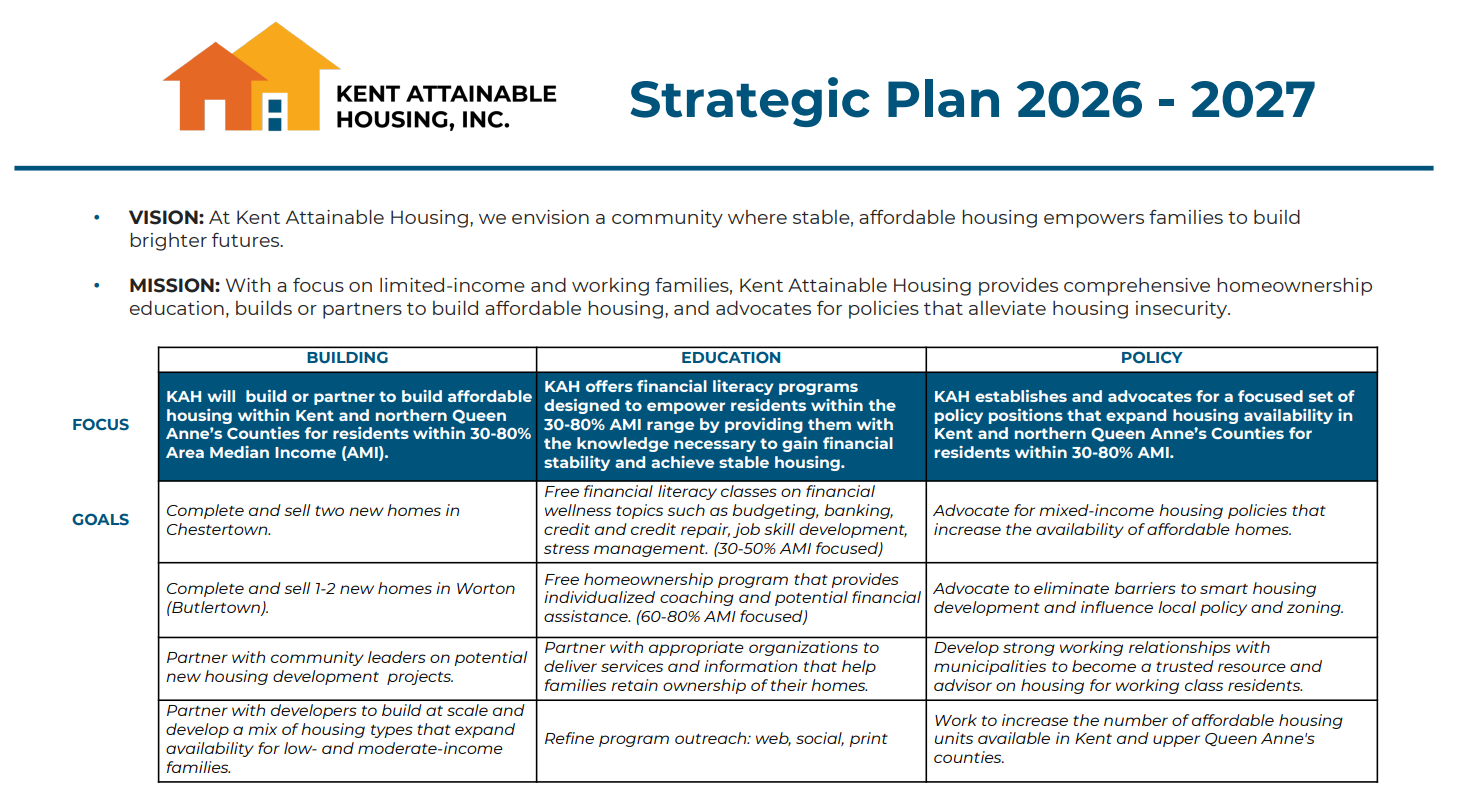
Those conversations informed a focused, two-year strategic plan built around three main pillars:
Transition from small-scale, grant-funded homebuilding to a sustainable, developer-partnered model capable of making a greater impact on affordable housing for lower-income residents.
Expand its financial literacy and homebuyer programs for Kent and northern Queen Anne’s County residents, prioritizing areas located in historically disinvested communities. Offered for free and open to the public in partnership with local financial experts, the programs are designed to help residents strengthen their financial well-being and identify pathways to homeownership.
Deepen collaboration with local, state, and national advocacy organizations working to reduce housing insecurity and strengthen communities.
Righi states, “Numerous research studies have shown that housing stability is essential for long-term financial security and well-being. Communities with affordable housing options are better positioned to support housing stability for service-sector and essential working families, who in turn contribute to a healthy local economy. At KAH, we believe that affordable housing is an important segment of economic infrastructure, as vital to a thriving community as roads, utilities, and internet connectivity.”
The Maryland Department of Housing and Community Development’s 2025 Housing Needs Assessment Report** concluded that in order to achieve housing stability for all Maryland residents, we must prioritize three key areas: increasing housing production through local upzoning to address land shortages and rising costs; expanding the production and preservation of protected affordable homes for vulnerable seniors and low-income renters; and increasing supportive housing options for those transitioning out of homelessness.
“We understand that addressing affordable housing requires multifaceted solutions, and tackling the complexities of housing stability is crucial for fostering healthier, more secure communities,” states Board President Joe Phillips. “Partnerships and collaboration are essential to this work. We are actively seeking developers and investors who want to help expand access to affordable housing in our region. We are also eager to explore innovative housing solutions, such as smaller homes, manufactured homes, and pocket neighborhoods, that can bring people together, strengthen ties among neighbors, and help build a stronger sense of community.”
The organization also invested in a redesigned website to help its stakeholders more clearly understand its mission, the communities it supports, and how to access available programs and services. The redesign also focused on improving online visibility so potential program participants can more easily find KAH when searching for housing-related topics online.
“Our website is the first encounter with Kent Attainable for many people,” said Righi. “We saw an opportunity to remove barriers to participation during that initial website visit, and we hope the updated site will make it easier for prospective homeowners and supporters to engage with us.”
* Data reported via the McKinney-Vento Act (42 U.S.C. § 11431 et seq.), a federal law that provides important educational rights and services to PreK-12 children and youth experiencing homelessness. “Homeless children and youth” are those who lack a fixed, regular, and adequate nighttime residence — including children sharing the housing of others due to loss of housing or economic hardship; living in motels, trailer parks, campgrounds, shelters, or transitional housing; or sleeping in cars, parks, abandoned buildings, or other similar places.
** https://dhcd.maryland.gov/Documents/Research/Compiled-Report-SHNA-2025.pdf